


Who Are They?
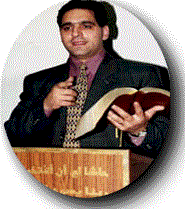
Persecuted For His Name, but His
Word is not chained
Arab ChristiansToday there are 14 Million Christians in the Arab world descendants of those who did not convert to nor embrace Islam. Palestine is well known in the Bible and it is considered the cradle of Christianity. There are several other Arab countries that capture portions of the Old and New Testaments passages namely Lebanon, Jordan, Egypt, Iraq and Syria. After the advent of Islam Christianity disappeared completely in certain countries such as Morocco, Algeria and Tunisia and the Arabian peninsula. Distribution of the Arab Christian PopulationsMost of the Arab Christians who live in the Middle East are located in the following countries:
In total about 5-6 % of the Arab countries population are Christians. It is important to note that Arabs are not all Muslims and Muslims are not all Arabs. Some Christians who live in the Arab world refuse to be considered as "Arabs". They take pride in their heritage and trace their roots to their ancestors who inhabited the land before the appearance of Islam. For example, Lebanese Christians take pride in their ancient Phoenician roots. Egyptian Coptics trace their roots to the ancient Egyptians under the Pharaohs dynasties. So the Chaldeans and the Assyrians of Iraq who consider themselves to be the original inhabitants and dwellers of present day Iraq.. Migration of Arab ChristiansA lot of Arab Christians migrated from Lebanon, Syria, Palestine and Iraq to Europe, West Africa, the American continent and Australia. Christian emigration from the Middle East has increased because of political and economic hardship (from Lebanon since the 1975-1990 civil war, from the Israeli occupied Palestinian territories, from Iraq since the UN sanctions destroyed the economy) and because of Islamic fundamentalist pressure. Denominations of the Arab ChristiansThe Arab Christians belong to more than a dozen different churches, the result of numerous conflicts and schisms since Christianity was adopted as the official religion of the Roman empire by the emperor Constantine in 313 AD. Four separate churches evolved around the capitals of the four ecclesiastical provinces:
Further divisions occurred in the fourth century (the Armenian Church), the fifth century (the Nestorian Church in Syria and Mesopotamia), the seventh century (the Maronite Church in Lebanon). With the Crusades, and later when the Ottoman empire grew weaker and local Christians sought sponsors in Europe, certain churches or parts of them associated with Rome and became known as the Uniate Churches. They kept a large degree of autonomy and retained their rites, customs (such as marriage for priests) and liturgical language (Syriac, Greek). This was the case with the Lebanese Maronites (however some Maronites say their church never separated from Rome but only lost contact). Later, in the 17th century, the Nestorians in Mesopotamia were divided in Chaldeans affiliated with Rome and non-uniate Assyrians. The Protestant Church in the Arab WorldIn the 19th century protestant, missionaries - notably American - followed in the footsteps of western Roman Catholic missionaries, and began proselytizing in the Arab world. Their enterprise was not very successful: conversion of Muslims was nearly impossible. The only converts were members of other nominal Christian churches. But they had nevertheless an important impact by creating educational institutions such as the American universities in Beirut and Cairo which contributed to the emergence of Arab nationalism. In its early stages these nationalist Christians from Lebanon, Syria and Palestine played an important role in the Arab national movement. In the 19th century Christianity was reappeared as a result of the presence in Sudan of Egyptian Coptic officials and traders during the Egyptian-British Condominium. Missionaries, Catholics and Protestants were allowed to work in the South and converted about 15 % of the local animist population. Colonial conquests also led to the reapparance of Christianity in the Maghreb, but without an impact on the local Arab societies. In Saudi Arabia, the cradle of Islam, all Christian activities, even for the numerous foreign workers, are strictly forbidden. The Arabic Evangelical Community of the Arab World |
|
- Hits: 29257